Squash Custard Pie

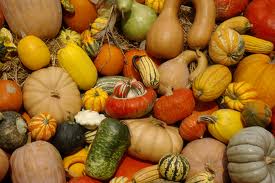
squashPumpkin pie is all the rage this time of year, but why just pumpkin?   Most pumpkins don’t have a lot of flavor (including the “sugar pie” small ones) and stores charge a premium price for pumpkin (often 2x 3x the price of other squash). The truth is that ANY winter (hard) squash will make an excellent “pumpkin” pie.  I prefer using butternut, or sweet meat, a turban, or even a couple of acorn squashes.
Cut the squash lengthwise, remove the seeds, and place face down in a pan with 1 inch of water in it. Cook the squash in the oven at 350 degrees Fahrenheit for 20-40 minutes (until a knife inserts easily).  Cool. Scrape out the insides, and place into a blender with a little milk or cream, and blend until smooth.

Recipe:

You’ll need 1 1/2 cups of puree squash for a 9″ pie shell.  Add spices (1/4 teaspoon cinnamon, 1/4 teaspoon ginger 1/4 teaspoon cloves, and 1/4 teaspoon nutmeg) stir in well.  Add 1/2 cup white sugar, and 1/4 cup brown sugar, and a pinch of salt (to taste).   In a separate bowl beat 2 eggs slightly, until the yolks are broken, mix in 1 1/3 cups of unsweetened evaporated milk, or heavy cream (the difference will be in the final product. The cream gives a smoother, denser, and richer pie.) Mix well, pour into unbaked pie crust.  Bake in a hot oven (425 degrees Fahrenheit) for 30-45 minutes (check often after the 25 minute mark) until a knife inserted into the center comes out clean.   Remove from oven, and cool.

Optional: to make the pie even richer, and darker in color, add a tablespoon of dark molasses.

Winter squash to use, include: Butternut, Blue Hubbard, Turban, Long Island Cheese, Kabocha, Sweet Dumpling,  Rouge Vif d’Etampes, Sweet Meat, White Pumpkin, Banana, Carnival, Delicata, Red Kuri, Buttercup (to name a few, this list is not complete).

Why stick with tired old pumpkin pie, when you can create a pie from any of the winter squashes?


Country Life, continued

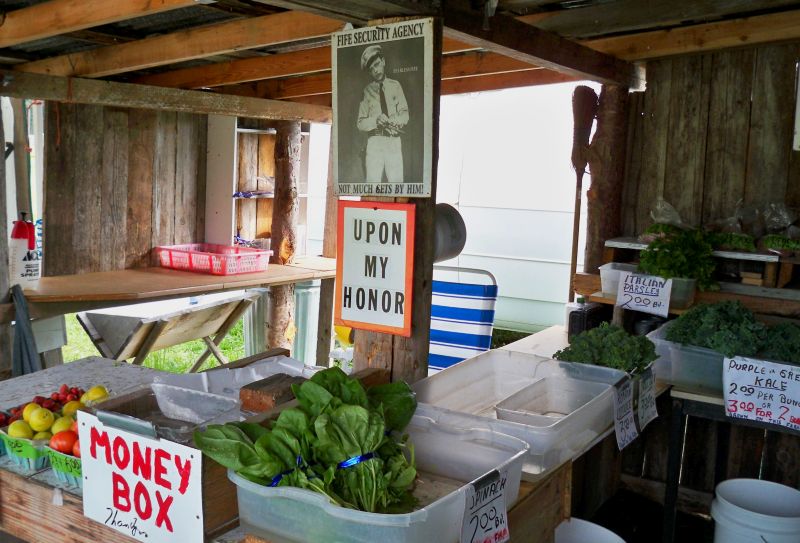
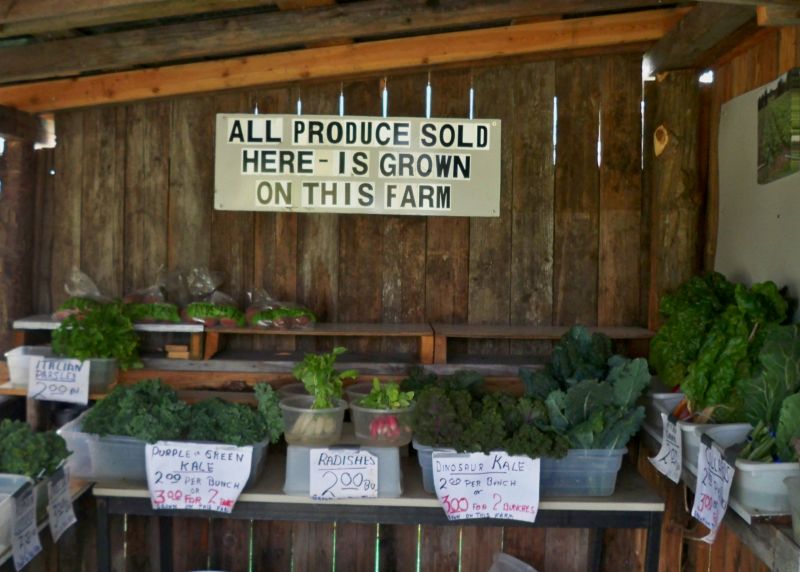
Honor boxes are great.  In the summer I visit a small little honor farm that has fantastic, fresh vegetables. The farm has been in existence since the 1920’s, by one family. I find it quaint. The quality is great — although, you have to expect a few earwigs, and the occasional baby slug, in the mix. The leaves might not be perfect (a few holes chewed through by some errant bug). But, what a bargain. I can’t eat $20 of vegetables in a week.  Cabbage, kale, collard greens, lettuces, squash, corn, beans, carrots, potatoes — come through from early summer to early autumn. vege honor farmvege honor farm 2

I place my money under a chunk of wood, and serve myself.  It’s absolutely why I love living out of the city.  There are a lot of honor boxes and little farm stands. There are even a few “pick it yourself” farms.  You go out into the field, and select the foods, and load up a basket.  Can’t get any fresher than that!

There is an honor honey shack, where I buy a glass quart jar of the amber gold, and a dairy farm that has a regular old refrigerator — full of fresh milk — sitting on a covered deck. (You put the money on the door shelf.)

There are cutting flower farms, too.

It is pleasant to take a drive, through the back roads, and frequenting these places.


Country Life

eggs signIt is getting to be that time of year again.  I think I look forward to the coming of Spring and Summer just as excitedly as I used to as a child.   Only my reasons have changed. As a kid, I would look forward to sleeping in, and long lazy hot days.

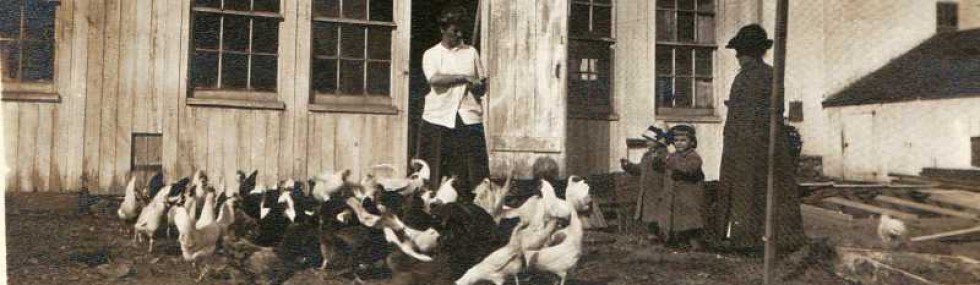
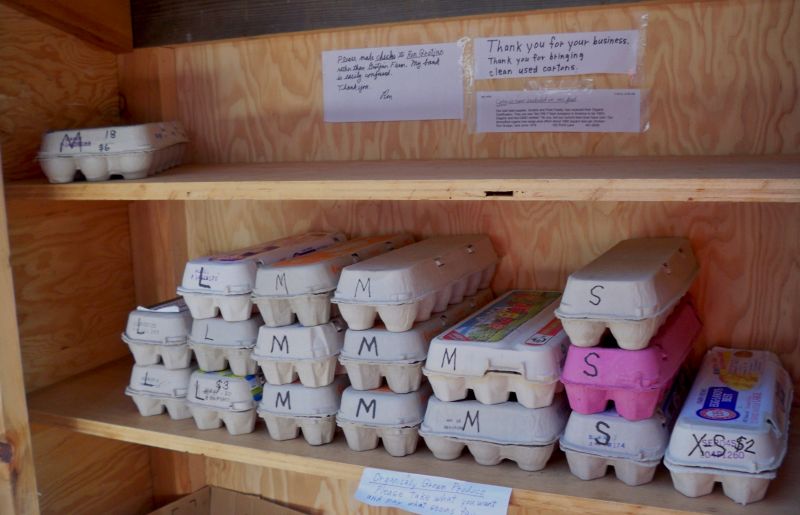
Now, giddy, I anticipate the honor farm’s return.  In the area I live, which is quasi-rural, driving the back roads you’ll see signs that announce that eggs are for sale.  The “honor box” payment system is very common around.  So, my regular weekly shopping includes stopping at a few of these rural shopping sites.   I go to the same place, usually, for eggs. It’s an amazing all freely pastured farm. Chickens hatch and raise their chicks, and everywhere there are chickens milling about.   It’s quaint.   The honor box that I stop at is simple, and you stuff your money down a little wooden slot.  egg honor boxThe eggs are fresh, the cartons are recycled (and I bring back my used cartons).   It’s pleasant.

I used to raise chickens, and have chickens, and nightly close them into their coop. Every morning let them out, and routinely clean out the coop. Uggh.  I have one of my original 25 left.  (I call her “survivor”.)

After years of struggling to protect chickens from neighborhood dogs, and marauding raccoons, foxes, eagles, coyotes, and whatever else, I’m tired of it.  But, there is no way I could go back to the big corporate egg farmed eggs.   (They have no taste! They have been in cold storage for half-a-year, or more.   Yuck.)

I also, use a lot of eggs — and try several egg recipes each week (for my “someday” book Too Many Eggs, it’s at 400 pages, now, and still growing).  I like to help support a guy who is, clearly, crazy about chickens.

egg farm

the egg farmer walking down his driveway

Rooster Got to the Egg and Other Yolks

One thing you’ll never see from a commercially produced egg is a “rooster spot” (aka meat spot). The scanning, washing, sorting, and weighing of eggs at commercial factories toss them aside for industrial cooking and baking (along with double yolks, and the extra small eggs).   With a fresh chicken egg, and especially young chickens — laying their first year — you will run into it a lot.red spot on egg  The old wives tale version of it was “that’s what the rooster contributed”. It’s not true. It’s just a slight malfunction in the egg creation process.   The little blood spot doesn’t flavor the egg, nor make it unsafe to eat.  Most people just take out the red spot with the tip of a knife.   Some people just cook the egg, and ignore it.  There are others that throw out the egg (an unnecessary reaction).

Most chickens will, eventually, stop throwing an off egg. But there are always mistakes that happen in the process. Some eggs will have double, triple, or more yolks (even if fertilized double chicks don’t develop, or survive). There are eggs with all egg white (often very small) called “wind eggs” or “fart eggs”.  And, depending on the chicken’s diet, egg yolk color will vary.  When chickens eat a great deal of green vegetable matter (they love to eat grass and weeds, and anything in your garden) and that will cause the egg yolks to have a brighter, deeper orange/yellow color.

Commercial eggs, by comparison, are often “colored” by use of annatto in the feed  (it’s not disclosed as the FDA has certified it as “exempt from certification” and considered natural).  Many people have sensitivities to annatto. People with nut and peanut allergies often react to it unfavorably. There has not been a widespread study about it. It’s just added to the chicken feed, colors the eggs, and that’s that.  Buyer beware, I guess.

But, people with a sensitivity to chicken eggs, might want to make sure the allergic reaction isn’t to annatto, instead of eggs.

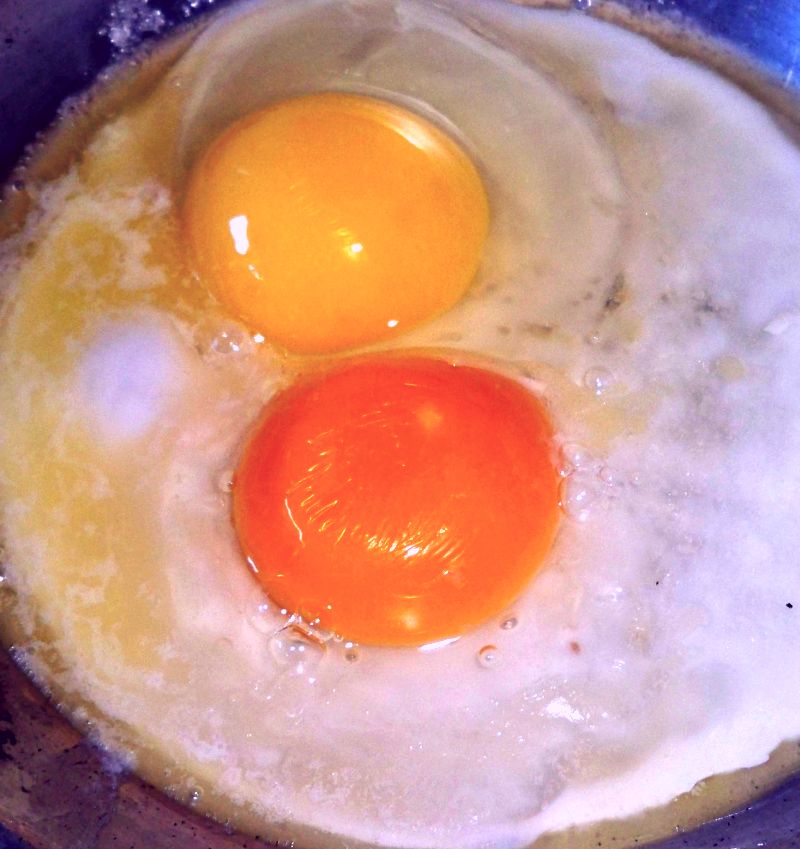
the difference in egg color is stunning. Which one is the "standard" store-purchased egg, and which is the backyard chicken egg. Can you tell?

variations in egg yolk color

The Yolk

Egg yolks are colored by xanthophylls, a yellow-orange pigment in green plants, yellow corn, and bugs. Yolk color is influenced by feed, exercise, and the lifestyle of the chicken.  Yolk color can be influenced by feed alone. In fact, a chicken running around in a yard, eating whatever it finds, is going to have varying yolk color intensity, depending on what is in season. Alfalfa creates a very light yellow yolk, whereas yellow corn can give a deeper yellow. More-intense-colored yolks are the result of feed with a heavy dosing of annatto or ample greens such as clover or kale; rye pasture; weeds such as mustard, pennycress, and shepherd’s purse; or feed that is high in beta-carotene vegetables such as carrots and beets. A quantity of red fruits can intensify the red-orange color of the yolk.

Exercise, pecking order, and bug eating contribute to the natural deep orange and/or red tones of a naturally colored yolk.

In the “modern world” we mess with mother nature.

Poultry raisers have long discussed influencing yolk color with various feed combinations to please their consumers. In 1919 a popular paper entitled “The influence of specific feeds and certain pigments on the color of the egg yolk and body fat of fowls,” by Leroy S. Palmer and Harry L. Kempster[1], was widely read. What the authors found was that “yellow corn is the best winter food for keeping up the coloring of adipose tissue during fattening” and that it was also what kept the egg yolks a nice sunny yellow color. Not too dark, not too light. People liked to purchase dressed chickens with a deep yellow skin color, and corn filled the bill. Corn, along with annatto (a derivative of the achiote tree, of tropical regions of the Americas, used in food dyes), is used heavily—to this day—in chicken feed to give a faux “healthy” yellow glow that normally could be found only in chickens raised in sunshiny fields.

A side note: Annatto has been linked with many cases of food-related allergies and is the only natural food coloring believed to cause as many allergic-type reactions as artificial food coloring. However, because it is not one of the “Big Eight” allergens (cow’s milk, eggs, peanuts, tree nuts, fish, shellfish, soy, and wheat) responsible for more than 90 percent of allergic reactions to food, its use is not regulated nor is a consumer able to avoid it easily (it’s rarely listed in labeling as anything other than “natural coloring”). Many people who consider themselves allergic to chicken eggs may, in fact, be allergic to the annatto feed additives.

Artificial egg coloring is still a very hot topic in poultry farming. Articles appear frequently in trade and scientific journals regarding the use of artificial and natural coloring agents in feed to intensify the yolk color of eggs and the skin color of chickens. One such article, “Formulation of Annatto Feed Concentrate for Layers and the Evaluation of Egg Yolk Color Preference of Consumers,”[1] in the Journal of Food Biochemistry (January 13, 2010), lays out the trickery that is rampant in the poultry industry:

Visual appearance, especially color, is one of the most important characteristics of foods and determines the acceptance or rejection of the product by the consumer. This statement is also true for poultry products, in which the color of skin, meat and egg yolk plays a fundamental role to some ethnic and regional consumers (Chichester, 1981; Hencken, 1992; Williams, 1992; Macdougall, 1994). The preference for well-pigmented poultry products is still evident in some markets, and thus, poultry producers add colorants to broiler and layer diets as a means of improving the attractiveness of these products (Klaui and Bauernfeind 1981; Hencken 1992; Liufa et al., 1997).

The interesting thing about the authors’ analysis is their assertion that the average consumer in the United States prefers a yolk that is a lighter yellow than what European consumers favor. This is presumably because those consumers have never eaten an egg from a chicken that pecks, scratches, chases bugs, and eats greens and weeds in a natural setting. The flavor and quality of eggs from a backyard chicken are vastly superior to what you get with commercially laid eggs.


[1] I. Ofosu, E. Appiah-Nkansah, L. Owusu, F. Apea-Bah, I. Oduro, I., and W. Ellis, “Formulation Of Annatto Feed Concentrate for Layers and the Evaluation of Egg Yolk Color Preference of Consumers,” 2010. Journal of Food Biochemistry, 34: 66–77. doi: 10.1111/j.1745-4514.2009.00264.x


[1] The Dairy Chemistry Laboratory and Department of Poultry Husbandry, University of Missouri, Columbia)

Columbia Cookbook (1902) Recipes, Continued…

The Columbia Cookbook recipes:

Eggs for Breakfast

Six eggs, one tablespoonful of flour, one slice of onion, six mushrooms, one tablespoonful of butter, two tablespoonfuls of cream, one bay leaf, one half-pint of white stock. Boil the eggs for fifteen minutes. Remove the shells, take out the yolks, being careful not to break them; cut the whites and mushrooms into dice. Put the butter on to melt, add the flour, mix until smooth; add the stock and cream, stir continually until it boils; add the salt and pepper, the whites of the eggs, and the mushrooms, stir over the fire until it comes again to a boil, throw in the yolks, and let it stand over the tea-kettle for one or two minutes until the yolks are heated. Serve in a small shallow dish.


Shirred Eggs

Set into the oven until quite hot a common white dish, large enough to hold the number of eggs to be cooked, allowing plenty of room for each. Melt in it the sauce. Put a few spoonfuls in the centre of the omelet before folding; when dished, pour the remainder of the sauce around it.


Scalloped eggs

Hard boil twelve eggs; slice them thin in rings; in the bottom of a large well-buttered baking-dish place a layer of grated bread crumbs, then one of the eggs; cover with bits of butter, and sprinkle with pepper and salt. Continue thus to blend these ingredients until the dish is full; be sure, though, that the crumbs cover the eggs upon top. Over the whole pour a large teacupful of sweet cream or milk, and brown nicely in a moderately heated oven.


To Bake Eggs

Butter a clean, smooth sauce-pan, break as many eggs as will be needed into a saucer, one by one; if found good, slip it into the dish; no broken yolk allowed, nor must they crowd so as to risk breaking the yolk after being put in; put a small piece of butter on each, and sprinkle with pepper and salt; set into a well-heated oven, and bake till the whites are set. If the oven is rightly heated it will take but a few minutes and is far more delicate than fried eggs.


Eggs in Marinade

Six eggs, one pint of vinegar, one half teaspoonful of salt, twenty-four white cloves, one half teaspoonful of ground mustard, one half teaspoonful of pepper. Boil the eggs fifteen minutes. Take off the shells and stick four cloves into each egg. Put the vinegar on to boil. Rub the mustard, salt, and pepper, with a little cold vinegar, to a smooth paste, and add to the vinegar when boiling. Stir over the fire one minute. Put the eggs in a glass fruit jar, pour over them the boiling vinegar, cover and let stand two weeks.  

These are nice to serve as an accompaniment to broiled steak.


Pickled Eggs

Boil them twenty minutes and place them into cold water to make the shells cool off easily; boil some beets very soft, peel and mash fine, and put them , with salt, pepper, cloves and nutmeg, into vinegar enough to cover the eggs. Put the eggs into a jar and pour the mixture over them.


Cupped Eggs

Put a spoonful of high-seasoned brown gravy into each cup; set the cups in a sauce-pan of boiling water, and, when the gravy heats, drop a fresh egg into each cup; take off the sauce-pan, and cover it close until the eggs are nicely and tenderly cooked; dredge them with nutmeg and salt. Serve them in a plate covered with a napkin.


Eggs sur le Plat

Butter the bottom of little egg basins or one large tin dish. Break one egg into each of the basins, being careful not to break the yolk, or six eggs may be broken in the large dish. Sprinkle with salt and pepper, and bake in a quick oven until the yolks are set. Serve in the dish in which they are cooked.


Stuffed Eggs

Six hard-boiled eggs cut in two, take out the yolks, and mash fine; then add two teaspoonfuls of butter, one of cream, two or three drops of onion juice, salt, and pepper to taste. Mix all thoroughly, and fill the eggs with this mixture; put them together. Then there will be a little of the filling left to which add one well-beaten egg. Cover the eggs with this mixture, and then roll in cracker crumbs. Fry a light brown in boiling fat.


Eggs aux fines Herbes

Roll and ounce of butter in a good teaspoonful of flour; season with pepper, salt, and nutmeg; put it into a coffee-cupfull of fresh milk, together with two teaspoonfuls of chopped parsley; stir eggs, and half them; arrange them in a dish with the ends upward, pour the sauce over them, and decorate with little heaps of fried bread crumbs round the margin of each egg.


Eggs a la Bonne Femme

Take six large eggs, boil them ten minutes; when cool, remove the shells carefully; divide them equally in halves, take out the yolks, and cut off from each the pointed tip of the white, that they may stand flatly; make tiny dice of some cold chicken, ham, boiled beet root, and the yolks; fill the hollows with these up to the brim, and pile the dice high in the centre — two of ham and chicken, two of boiled beet root, and two with the hard yolks; arrange some neatly cut lettuce on a dish, and place the eggs amongst it.

Columbia Cookbook (1902) More Recipes

Omelet Soufflee

Whites of six eggs, yolks of three eggs, juice of half a lemon, three tablespoonfuls of powdered sugar. First grease a quart baking dish with butter, and then see that the oven is hot. Now beat the whites to a very stiff broth, beat the yolks, add them to the whites, then the sugar and juice of a lemon; stir carefully, and quickly heap into the baking dish; dredge with powdered sugar and put into the oven. Bake fifteen minutes or until a golden brown, and serve immediately. It may also be baked in paper cases.

Rum Omelet

Put a small quantity of lard into the pan; let it simmer a few minutes and remove it; wipe the pan dry with a towel and put in a little fresh lard in which the omelet may be fried. Care should be taken that the lard does not burn, which would spoil the color of the omelet. Break three eggs separately, put them into a bowl, and wisk them thoroughly with a fork. The longer they are beaten the lighter will the omelet be. Beat up a teaspoonful of milk with the eggs, and continue to beat until the last moment before pouring into the pan, which should be over a hot fire. As soon as the omelet sets, remove the pan from the hottest part of the fire. Slip a knife under it to prevent sticking to the pan. When the centre is almost firm slant the pan, work the omelet in shape to fold it easily and neatly, and when slightly browned hold a platter against the edge of the pan and deftly turn it out on to the hot dish. Dust a liberal quantity of powdered sugar over it and singe the sugar into neat stripes with a hot iron rod, heated in the coals; pour a glassful of warm Jamacia rum around it, and when it is placed on the table set fire to the rum. With a tablespoon dash the burning rum over the omelet, put out the fire and serve. Salt mixed with the eggs prevents them from rising, and then it is so used the omelet will look flabby, yet without salt it will taste insipid. Add a little salt to it just before folding it and turning out on the dish.

Smoked beef with Eggs

Cut some smoked beef in thin shavings or chips, put them into a frying pan, and nearly fill it with hot water; set it on the fire and let it boil up once, then pour it off; add to the beef a good bit of lard, twice the size of an egg, for a half pound of the beef, shake a little pepper over it, and let it fry for a few minutes over a quick fire; then break two or three more eggs into it, stir them together until the eggs are done and then turn it onto a dish. Or, after frying the beef with a little wheat flour dredged over, fry eggs, and serve with it the same as ham.

Ham and Eggs

Fry the eggs in a little every nice salted lard; drain off every drop of grease and lay them upon a hot dish with neat slices of fried ham around the edges., half the size of the slice as the first, carved from the ham. Trim off the rough edges of the eggs, and cut the ham evenly in oblong pieces before dishing. Garnish with parsley.

Egg Nogg

Beat the yolks of twelve eggs very light, stir in as much white sugar as they will dissolve, pour in gradually one glassful of brandy to cook the eggs, one glassful of old whiskey (or two glassfuls of sherry wine), one grated nutmeg, and three pints of rich milk. Beat the whites to a froth and stir in last.

Egg Sauce

Three hard boiled eggs, a good teacupful of drawn butter, a little salt. Chop the yolks only of the eggs very fine, and beat into the hot drawn butter, salting to sates.  This is used for boiled fowls and boiled fish. For the former, you can add some minced parsley; for the latter chopped pickles, caper, or nasturtium seed. For boiled beef, a small shallot minced fine.


Just Mayonnaise v.s. Mayonnaise/Miracle Whip

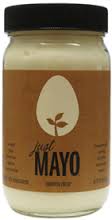
justmayoAlthough I’m usually for the underdog, I can’t see how anyone can call a slurry of ingredients mayonnaise when it lacks eggs for the emulsion base.   JUST Mayo is something, but it is NOT mayonnaise.

I must agree with Michael Faherty, Vice President of Unilever Foods North America when he said: “This is about misleading consumers.”

I am no fan of prepackaged foods, in any shape or form, from big multinational corporations to little suppliers.  But, I am more disturbed by the attitude that  “we can call anything, anything we want” mindset, and even more so when it comes to consumer products.

I don’t think consumers should bear the brunt of what is, clearly, false advertising. In 1933, Miracle Whip was found to not be mayonnaise because it lacked enough oil.  It also (to mayonnaise v.s. Miracle Whip advocates) doesn’t taste the same. So, why should a product that doesn’t contain eggs be confused with the real thing?   Mayonnaise has been mayonnaise since the 1700’s, why are we even entertaining the notion that Just Mayonnaise is anything except a fraud?  Let it find a new name for the new product.

If I want to buy prepared mayonnaise, I’d like to buy a product containing: oil, eggs, an acid containing food (vinegar or lemon juice, typically), maybe some salt, maybe some mustard (helps keep the emulsion intact).  That is what mayonnaise is made of.

If I buy Hellman’s/Best Foods Mayonnaise I get: soybean oil, water, whole eggs and egg yolks, vinegar, salt, lemon juice, and calcium disodium EDTA.  I’m not thrilled about the soybean oil or the calcium disodium (used to keep the emulsion together, and give it longer shelf life).  But I’m getting the basic ingredients of a mayonnaise I can create at home.

You cannot recreate “Just Mayonnaise” at home.

Why?  Just Mayo‘s ingredients:

  • Non-GMO Expeller Pressed Canola Oil
  • Filtered Water
  • Lemon Juice
  • White Vinegar
  • 2% or less of the following: Organic Sugar, Salt, Pea Protein, Spices, Modified Food Starch, Beta-Carotene

What is missing?  EGGS!

Oil into vinegar is an emulsion, but a weak one.  There’s no body to it, so to get the egg substitute (and color, along with the vegetable coloring in beta-carotene) Just Mayonnaise uses a pea protein extracted from Canadian yellow peas along with modified food starch. This gives the emulsion something to cling to, and mix with. It is a vastly different emulsion than one with egg yolks, though.   And, what IS “pea protein” and what IS “modified food starch”?

The pea protein is put through a chemical/heat process to break it down to its essential elements. In chemical terms it is: extracted with alkaline solution followed by acid precipitation.  The common method is called acid-hydrolyzed. The legume (soybean, pea, bean, garbanzo, etc.)  is cooked at a temperature between 90 °C and 120 ° for up to 8 hours in a diluted (15-20%) hydrochloric acid solution. Then it is neutralized with either sodium carbonate or sodium hydroxide (ph of 5 or 6).  The hydrolysate (i.e. the neutralized sludge) is filtered, several times, to remove the insoluble parts, and then filtered through activated charcoal to take out any off-flavors.  Then it is then spray-dried, or vacuum dried and ready for use as a food ingredient.

HPV (hydrolyzed vegetable protein) is in a wide array of foods, and there have been several major recalls because of Salmonella contamination. It is used in prepared soups, sauces, chilis, stews, hot dogs, gravies, salad dressings, snack foods, chips, dips, and blended with other spices to flavor foods.  The unfortunate fact is that HPV is a source of MSG (monosodium glutame) that same food additive that is implicated in headaches, discomfort, and other allergy trigger symptoms, as well as fibromyalgia, depression and hyperactivity.  MSG is often disguised in food labels as “natural flavors”, and as vegetable protein.

A modified food starch involves boiling a starch with inorganic acids (such as hydrochloric acid or sulfuric acid) to break down the starch molecule to lower the viscosity (make it stiffer, in essence).  The long term health effects of ingesting these things is unknown, as there have been no publicly-released studies. If the starch used in modified corn starch, potato, or tapioca (only modified wheat starch must be labeled “wheat”) it will, usually, contain up to 10% maltodextrin, anther way that MSG (monsodium glutamate) is hidden in prepared foods.

(Note: A large number of modified starches are made in China. If you consider the issues with lead poisoning of toys, and melamine poisoning of infant formula and pet food, you might want to rethink ingesting this stuff.)

You CAN make mayonnaise at home —

Basic Mayonnaise recipe:

  • 3 egg yolks
  • 1 tablespoon wine vinegar or lemon juice
  • 1/2 teaspoon salt
  • 1/4 teaspoon prepared mustard
  • 1 1/2 cups olive oil, salad oil, or mixture
  • 2 tablespoons boiling water

Beat egg yolks with salt, mustard, and vinegar or lemon juice. Add oil, a drop at a time, and keep beating. Dribble oil in, in short bursts, beating constantly to make sure egg mixture absorbs oil smoothly. Dribble, and then stop and beat. Dribble, stop, and beat. When 1/3 cup oil is mixed in, the chance of the whole sauce breaking is lessened, so you can add oil in larger amounts (such as a teaspoon at a time). Continue until all oil has been used. The end result will be very thick and creamy. Thin with a little boiling water or a mixture of hot water and more vinegar or lemon juice if mixture is too thick. Add seasoning after mayonnaise has been chilled, covered, for an hour. (If not covered, it may develop an unsightly “skin” on top.)

Mayonnaise v.s. Miracle Whip

Mayonnaise is not to be confused with Miracle Whip, which is mayo-like, but has an obvious SWEETNESS to it.  It was created as an alternative to mayonnaise, and there are those who prefer it.  (I do not.) It has more ingredients including sugar (in the original recipe, now it’s high fructose corn syrup and solids), garlic powder, paprika, and a few other “proprietary blend” spices/flavors.  In 1933, the FDA decided this was not mayonnaise because it lacked the 65% oil, and had the extra ingredients.

You CAN make a Miracle Whip clone at home:

Nearly Miracle Whip

  • 1 egg yolk
  • 4 teaspoons white vinegar
  • 1 teaspoon apple cider vinegar
  • 1/3 teaspoon lemon juice
  • 4-5 teaspoons white sugar (to taste)
  • 1/4 teaspoon salt
  • 1 cup oil (bland olive oil, saffola oil, etc.)
  • 1/4 teaspoon dry mustard (or 1/2 teaspoon prepared mustard)
  • paprika and garlic powder (to taste).

Combine vinegars, lemon juice, and stir in salt until dissolved. Mix into the egg yolk, whisking until fully combined.  Slowly add oil, a drop at a time, whisking constantly until the oil is absorbed by the yolk/vinegar mixture. When it is thickened, add mustard, and spices, and mix in well.   Chill before using for best flavor. Good in refrigerator for up to 7 days.