Dessert Deviled Eggs

Everyone knows variations on deviled eggs, but what about dessert deviled eggs?

These two recipes are fantastic (and not just for the shock {wow} factor) Perfect for a potluck:

Chocolate Deviled Eggs

12 hard-boiled eggs, peeled

¼ cup unsalted butter, softened

¼ cup cream cheese

¼ cup superfine sugar

1 tablespoon unsweetened cocoa powder

several drops vanilla extract

¼ cup whipping cream

cocoa powder for garnish

Remove yolks from eggs, and set whites aside. With fork mash yolks and put into bowl. Add room-temperature butter and cream into yolks. Add room-temperature cream cheese, and blend into butter mixture. Add sugar, cocoa powder, and vanilla extract, and blend in well. Put spoonfuls of yolk mixture back into egg whites, and reassemble both egg halves. Refrigerate to firm. To serve, whip up whipping cream with small amount of sugar, place dollop of whipped cream on plate, and place egg on top. Sprinkle with cocoa powder.

Italian Sweet Hard-Boiled Eggs

8 hard-boiled eggs, peeled

½ cup butter, softened

¼ cup sugar

several drops vanilla extract

¼ cup flour

½ cup cornstarch

Cut eggs in half, and separate yolks from whites. Set whites aside. Mash yolks with fork. Cream butter and yolks, and add sugar and vanilla extract. Stir together flour and cornstarch, sprinkle a little at a time onto yolk mixture, and blend in. Fold until flour is incorporated. Make firm ball with dough. Refrigerate 2 hours. Remove, and make 16 small balls of dough. Place a dough ball in cavity of each egg white. Flatten dough slightly. Place on cookie sheet. Bake in 350-degree oven 10 to 12 minutes or until light golden-brown. Serve warm, or chilled.

The Science of Cooking an Egg

The egg white coagulates (turns from liquid and solidifies) at a temperature between 144 and 149 degrees Fahrenheit (62 and 65 Celsius). Egg yolk coagulates between 149 and 158 degrees Fahrenheit (65 and 70 Celsius). This difference in coagulation is why you can fry an egg and have the white fully solidify while the yolk remains runny or, for the sake of this chapter, how you can cook a soft-boiled egg so that the white is fully opaque while the yolk is still runny.

The coagulation is referred to as curdling in older recipes. It does describe the chemical reaction within the egg. When eggs are heated, the long chains of amino acids unfold and straighten out, and then as the temperature increases (to the ideal coagulation point), the proteins create stronger, firmer new bonds. The biological terminology for this is denaturing the protein. Denaturing is what happens when you cook an egg: in frying, when it forms a solid mass, and in scrambling, when it turns into soft lumps, or curds.

However, the current scientific definition of curdling is syneresis. (Syneresis is the separation of liquid from a coagulated mass, such as what happens in cheese-making when whey separates from the cheese curds.) In the case of eggs, their protein becomes overcoagulated and “breaks.” When this happens, liquid is forced out of the lumps of protein. Without liquid, the protein binds together more tightly. The result is a lumpy, almost granular texture.

Too high a heat or an overly long cooking time can cause this. When it happens, the cooking term (when one is talking about a sauce, for instance) is that it breaks. A break is considered to be a total and utter failure of the sauce, the custard, the emulsion.

Newer cookbooks and recipes on the Web try to slap on scientific names (used in other cooking science such as cheese-making) that are not a good fit. The point is that the modern definition that associates egg curds with syneresis (instead of denaturing) is confusing. Borrowed descriptive terms are not a good fit for cooked eggs.

Egg Proteins Altered

There are three ways to change the proteins in eggs: heat, beating, and chemical reaction.

1.) Heat causes the proteins to unfold and reconnect. Moderate heat (medium or medium-low) is better than high heat, which causes the bonds to connect too strongly, resulting in a rubbery, tough cooked egg. If you boil an egg on too high a heat, you may see a greenish tinge on the cooked egg yolk if the iron sulfide in the yolk reacts with the hydrogen sulfide in the white (This does not change the quality or the flavor of the egg, but it looks unattractive.)

2.) Beating or whisking egg whites causes the protein bonds to break and reconnect. The new bonds are stronger and cross-linked. Once an egg yolk is whipped into a foam, it will not return to a liquid.

3.) Chemicals that can denature, or break, the protein bonds in eggs include vinegar, lemon juice, cream of tartar, and alcohol. Numerous recipes call for the addition of an acid to egg whites for meringues, soufflés, sponge cakes, and the like, because it lengthens the protein strands and allows for stiffer egg white foam.

Egg whites are easier to alter than egg yolks, because the proteins in egg yolks are more resistant to change.

Urban Chicken Wrangler

I go into the feed stores, and hear the peeping. It is so hard to resist the chicks. So cute running around pecking. Its hard for me to resist.

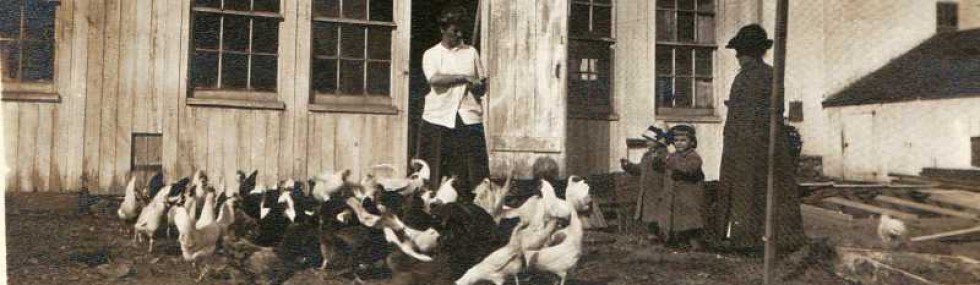
I think everyone should have a chicken or two, in their lives. When I lived in an urban center, I  decided that I just HAD to have some chickens. (We already had a duck that my daughter had talked me into, and, of course, you can’t just have one duck, so we had three.)

As I discovered…a lot of people have chickens. My UPS guy, the mailman,the clerk at the grocery store…a few teachers at my daughters school. I even joined an “urban chicken” club. I found people who showed chickens.  (I found this weird.) There is a lot more poultry around in cities that would seem “normal”. I had no idea until I had chickens. It was like being pregnant, you don’t notice anyone is pregnant until you are, then you see pregnant women EVERYWHERE.  In this case, I didn’t now that there was a very active underground poultry society until I had my own.

smaller chicken and laundry

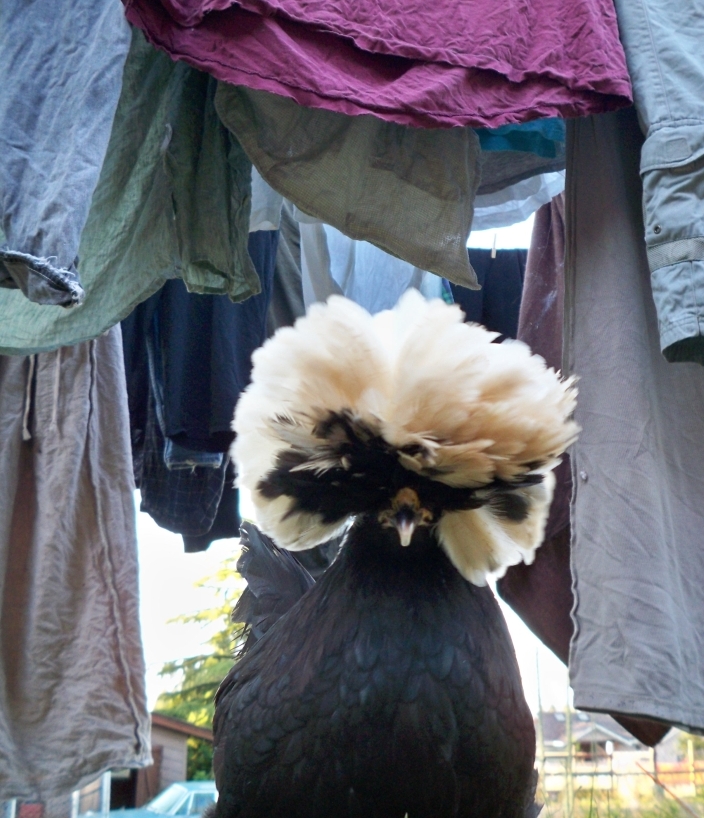
White Crested Black Polish chicken under my clothesline.,

I learned by trial-and-error, and from other people. But, compared to a lot of pets, chickens are the least demanding of any pet I’ve ever owned. In the beginning, I had two full-sized birds, and two bantam “Silkies” (very odd little birds). Bantams are half-sized chickens…so chicken lite, and they lay these cute little eggs. (Great for a diet.) The challenge was in keeping them safe. So, we trained them to go into portable dog kennels (the airline type) every night, and then haul them in the house. (I say “train” this consisted of seeking them from wherever they had decided to roost in the yard, and snagging them, putting them INTO the kennel every night…until they figured out that the kennels were the safe spot to go. However, if you don’t put the kennels in the exact same spot every day, they get confused.  Then they’ll go back to plucking them from bushes and trees every night. (Which sucks.)  I started leaving the kennels where they were, from when I left them out.  The chickens got the clue, and sometimes would lay their eggs IN the kennels, which made me happy. But, sometimes I’d forget, or one of the kids would move the kennels, and that night, I was again, out after dark, with a flashlight searching for where the chickens were hiding. When you snatch a chicken in the dark, it makes a terrible, terrified noise. Poor things sound pitiful.  It did anchor me around their schedule, until I built a hen-house and yard with a covered top and sides. It was a constant worry and race to get home “before it was too dark” to put them inside.

On second thought, maybe they trained me.
In the day they’d go out in the yard and run around. Eat bugs, and we’d give them a little grain and leftovers in the morning, and a small amount of grain at night, about an hour before sunset. (I didn’t like to keep food out because I didn’t want rodents.)  Grain is chicken crack, by the way, they’ll eat that before they eat anything else.

I’ll admit, I was ready to throw in the towel, at first.  I mean, chicks are cute, but the teen chickens are just jerks. They are messy, loud, and smelly.  But, once we had the eggs — that was is IT! We were addicted. With only four layers (two small eggs and two large) we would wait with anticipation of “someone laying”. On average, two eggs a day, was more than a dozen a week. That was great. (Back then I wasn’t all that into eggs.)

Once I moved to a quasi-rural area, I ordered 25 from McMurray (big online/catalog hatchery). I cannot tell you that 25 are as easy as a few. They aren’t. Even with a big, “formal” hen-house, there is a lot more cleaning, more heartache. We’ve had problems with when raccoons discovered the easy pickings, eagles swooping down, large ravens taking a few out, a local dog had a blast one afternoon.  Chickens are prey. They’re not always smart enough to get out of harm’s way. And, then, the chicken breeds, themselves.  I wish I’d paid more attention to when the catalog said “calm bird” or “good foragers” “lively”, etc.   I’ve come to find out “alert” and the “good forager” are polite terms for crazy chickens!  And chickens that are “good mothers” also mean that they’ll go broody, all summer long. (A broody hen is one that stops laying, and starts gathering every egg they can find to put under her ample butt, so that she can hatch them. Often a broody hen will defend the eggs, with a vengeance, and will also go rogue in your yard somewhere – MIA.  The broody hen won’t eat or drink, either.)

The bigger heavier breeds are much easier to deal with. I am a huge fan of the Orpington breed (especially the Buff Orpington).

Two dozen chickens produced up to two dozen eggs a day.  On average, it was, at the very least, a dozen a day (and with the ducks, another half-dozen, and when the geese are laying another four. Eggs, eggs, eggs!) For a while, I tried to supply most of my neighbors with eggs, until they were politely saying “no thanks”.  I baked a pound cake each week. Made angel food cakes (hey! uses a dozen) and custards, and searched for more recipes.  I froze eggs (separated works best).  I even started (recycling?) cooking up the eggs to feed back to the hens . (Cook the eggs before giving them back to the hens so they don’t start eating their own eggs, and cut out the middle-man: YOU.)

Over the years my chicken population has dropped (from the aforementioned predators), to a more manageable number of chickens.  I think that two chickens for each person in the household is the right number of chickens.

Poultry is about the closest you’ll get to having dinosaurs in your yard. Chickens are amusing to watch.  And, can they eat! They are eating machines. The bugs in the yard get gobbled up and, most important: they eat leftovers.  No more guilt over tossing out a stale loaf of bread, or the rice that no one seems to want to eat as a leftover,  or that last bit of breakfast cereal at the bottom of the box…that the kids won’t eat because there isn’t enough for a full bowl. They also gobble up peanut butter and jelly sandwiches that come back from a packed school lunch all squished and miserable looking, vegetable trimmings, and wilted vegetables, bruised apples, and whatever else that would usually go into the trash can or garbage disposal.

I would recommend poultry for anyone. It’s hard to be depressed and feeling lonely when you have a flock of poultry that think you are a food god! You can’t be unhappy when all the chickens immediately stop whatever they are doing and  run over to see what you have for them. It adds a nice balance to life. They are always happy to see you.

My Experience With Eggs: Testing for Freshness

If you have chickens you will get used to testing the freshness of eggs. It becomes second nature, after a few “bad eggs” which are gross and disgusting.  I’ve never had any luck with candling.  I do know that if you shake an egg and it makes a noise, throw it out!

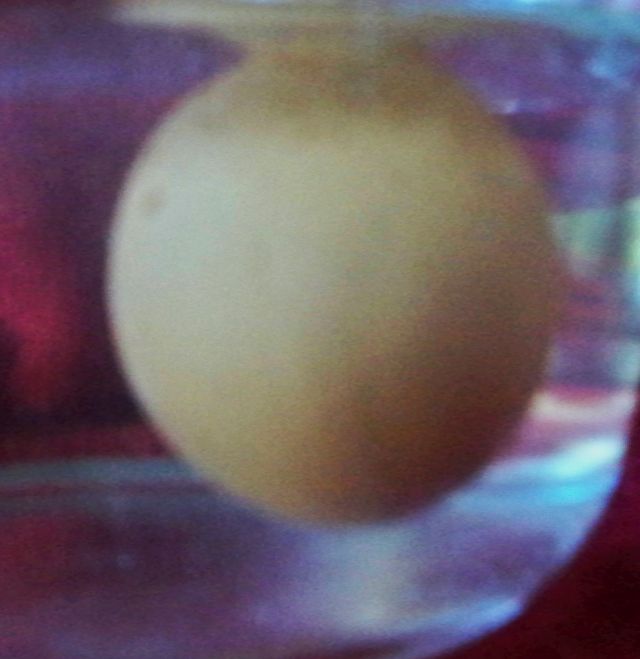
floaty egg

this egg is floating. It’s gone bad.

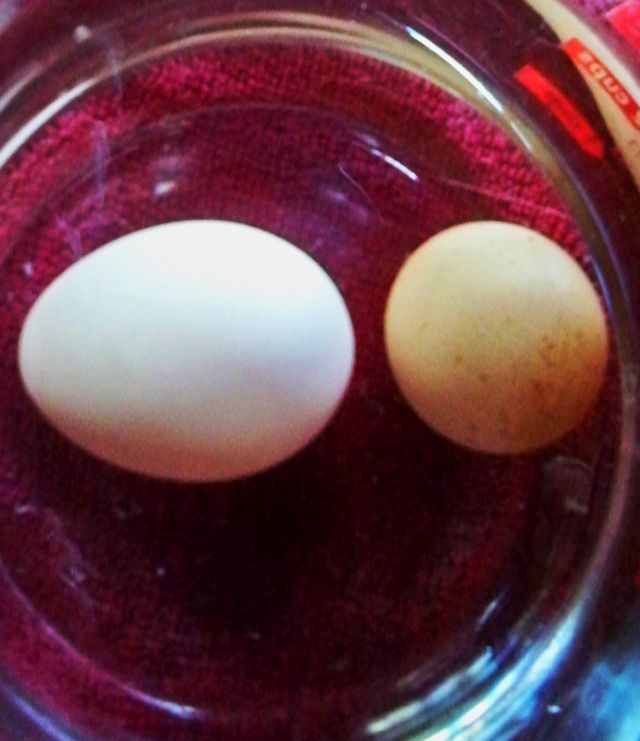
float eggs

white egg is laying at the bottom of the glass of water, the brown egg is tipping up slightly. Both are good to eat.

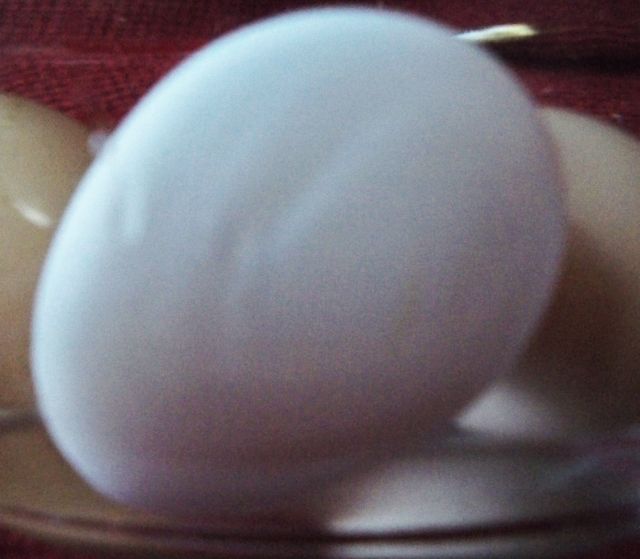
aged egg photo

this egg is tipping up. It’s older, but still good to use.

To test eggs:

Take a glass of cold water, put the egg in.

  •  If the egg lays flat on the bottom, it’s fresh, too fresh to boil, or fry sunny side up.
  •  If the back (round, not pointy end) tilts up just a bit…it’s ready for sunny side up cooking.
  •   If the round part of the egg tilts up a bit more….then it’s good for hard boiling (before that stage you just cannot PEEL them worth a darn, the shell sticks to the white).
  •   If the egg rises off the bottom of the glass and appears to dance, or floats….toss it. Too old!

Old cookbooks caution you to break each egg onto a saucer, and only use the eggs that look fresh.  If you start cracking and dropping eggs into the frying pan, there will eventually be a bad egg which ruins the bunch.  There is nothing more challenging than a rotten egg in a mess of good ones.  The only thing to do is toss it out and start over.

Some things I’ve learned by experience, that I wish someone had told me about:

  1. A fresh egg will smell faintly like the ocean. A newly laid egg will have a nice round yolk, but it will flatten slightly.  An “aged” egg (a few days under refrigeration) will have lost some moisture, so the yolk will be round and firm, tougher, and sit higher than the white.  But, occasionally, there are eggs which have flat yolks, period.  They never firm or round up. (But they are still good, and fresh). In the “egg industry” these are often sold commercially, to bakers, mostly.
  2. If there is a developing chick the egg might actually lay flat in the water. But, if you hold the egg to light, it will have a pinkish caste to it.  It will feel slightly heavy, and won’t spin like a raw egg, but faster, more like a hard boiled one.  You candle it (look at it with a strong light behind it) you might see an embryo. One end will be dark. If you shake it, there will be a thump.  You do NOT want to crack that open. Toss it.  (And, if you’ve already jostled it around, you cannot return it to get hatched because the movement has killed the embryo.)
  3. Weird looking eggs (including small, very large, strange shaped) should be tossed. Occasionally there are eggs, which are called “fart eggs” because they have no yolk, just white.  Occasionally eggs have a tough membrane, but no shell.  (They usually break when they are laid, and the contents are eaten by the chickens.)
  4. If you find an egg that looks very dark and floats right to the top of the water – handle this as if it were a live hand grenade. (If you hold it up to light it looks dark green and ominous.) Handle this with extreme care! Put it in several plastic bags and take it outdoors to the trash.  A rotten egg is something you never want to experience, ever.  I brought one into the house and figured it was old, but not bad.  It exploded with a loud pop. One word: yuck.


Rooster Got to the Egg and Other Yolks

One thing you’ll never see from a commercially produced egg is a “rooster spot” (aka meat spot). The scanning, washing, sorting, and weighing of eggs at commercial factories toss them aside for industrial cooking and baking (along with double yolks, and the extra small eggs).   With a fresh chicken egg, and especially young chickens — laying their first year — you will run into it a lot.red spot on egg  The old wives tale version of it was “that’s what the rooster contributed”. It’s not true. It’s just a slight malfunction in the egg creation process.   The little blood spot doesn’t flavor the egg, nor make it unsafe to eat.  Most people just take out the red spot with the tip of a knife.   Some people just cook the egg, and ignore it.  There are others that throw out the egg (an unnecessary reaction).

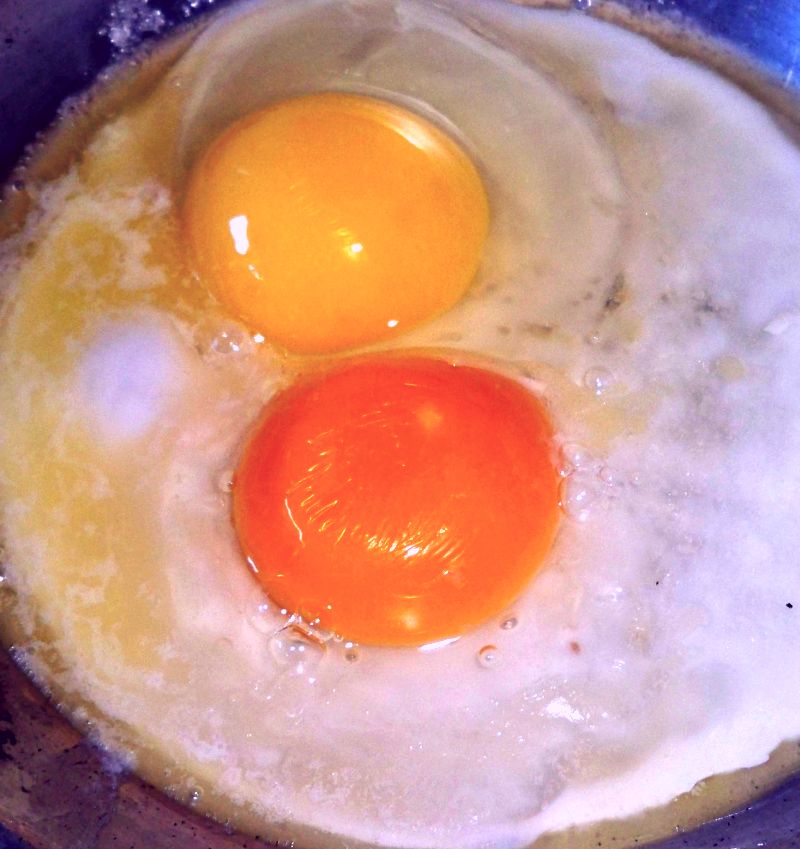
Most chickens will, eventually, stop throwing an off egg. But there are always mistakes that happen in the process. Some eggs will have double, triple, or more yolks (even if fertilized double chicks don’t develop, or survive). There are eggs with all egg white (often very small) called “wind eggs” or “fart eggs”.  And, depending on the chicken’s diet, egg yolk color will vary.  When chickens eat a great deal of green vegetable matter (they love to eat grass and weeds, and anything in your garden) and that will cause the egg yolks to have a brighter, deeper orange/yellow color.

Commercial eggs, by comparison, are often “colored” by use of annatto in the feed  (it’s not disclosed as the FDA has certified it as “exempt from certification” and considered natural).  Many people have sensitivities to annatto. People with nut and peanut allergies often react to it unfavorably. There has not been a widespread study about it. It’s just added to the chicken feed, colors the eggs, and that’s that.  Buyer beware, I guess.

But, people with a sensitivity to chicken eggs, might want to make sure the allergic reaction isn’t to annatto, instead of eggs.

the difference in egg color is stunning. Which one is the "standard" store-purchased egg, and which is the backyard chicken egg. Can you tell?

variations in egg yolk color

The Yolk

Egg yolks are colored by xanthophylls, a yellow-orange pigment in green plants, yellow corn, and bugs. Yolk color is influenced by feed, exercise, and the lifestyle of the chicken.  Yolk color can be influenced by feed alone. In fact, a chicken running around in a yard, eating whatever it finds, is going to have varying yolk color intensity, depending on what is in season. Alfalfa creates a very light yellow yolk, whereas yellow corn can give a deeper yellow. More-intense-colored yolks are the result of feed with a heavy dosing of annatto or ample greens such as clover or kale; rye pasture; weeds such as mustard, pennycress, and shepherd’s purse; or feed that is high in beta-carotene vegetables such as carrots and beets. A quantity of red fruits can intensify the red-orange color of the yolk.

Exercise, pecking order, and bug eating contribute to the natural deep orange and/or red tones of a naturally colored yolk.

In the “modern world” we mess with mother nature.

Poultry raisers have long discussed influencing yolk color with various feed combinations to please their consumers. In 1919 a popular paper entitled “The influence of specific feeds and certain pigments on the color of the egg yolk and body fat of fowls,” by Leroy S. Palmer and Harry L. Kempster[1], was widely read. What the authors found was that “yellow corn is the best winter food for keeping up the coloring of adipose tissue during fattening” and that it was also what kept the egg yolks a nice sunny yellow color. Not too dark, not too light. People liked to purchase dressed chickens with a deep yellow skin color, and corn filled the bill. Corn, along with annatto (a derivative of the achiote tree, of tropical regions of the Americas, used in food dyes), is used heavily—to this day—in chicken feed to give a faux “healthy” yellow glow that normally could be found only in chickens raised in sunshiny fields.

A side note: Annatto has been linked with many cases of food-related allergies and is the only natural food coloring believed to cause as many allergic-type reactions as artificial food coloring. However, because it is not one of the “Big Eight” allergens (cow’s milk, eggs, peanuts, tree nuts, fish, shellfish, soy, and wheat) responsible for more than 90 percent of allergic reactions to food, its use is not regulated nor is a consumer able to avoid it easily (it’s rarely listed in labeling as anything other than “natural coloring”). Many people who consider themselves allergic to chicken eggs may, in fact, be allergic to the annatto feed additives.

Artificial egg coloring is still a very hot topic in poultry farming. Articles appear frequently in trade and scientific journals regarding the use of artificial and natural coloring agents in feed to intensify the yolk color of eggs and the skin color of chickens. One such article, “Formulation of Annatto Feed Concentrate for Layers and the Evaluation of Egg Yolk Color Preference of Consumers,”[1] in the Journal of Food Biochemistry (January 13, 2010), lays out the trickery that is rampant in the poultry industry:

Visual appearance, especially color, is one of the most important characteristics of foods and determines the acceptance or rejection of the product by the consumer. This statement is also true for poultry products, in which the color of skin, meat and egg yolk plays a fundamental role to some ethnic and regional consumers (Chichester, 1981; Hencken, 1992; Williams, 1992; Macdougall, 1994). The preference for well-pigmented poultry products is still evident in some markets, and thus, poultry producers add colorants to broiler and layer diets as a means of improving the attractiveness of these products (Klaui and Bauernfeind 1981; Hencken 1992; Liufa et al., 1997).

The interesting thing about the authors’ analysis is their assertion that the average consumer in the United States prefers a yolk that is a lighter yellow than what European consumers favor. This is presumably because those consumers have never eaten an egg from a chicken that pecks, scratches, chases bugs, and eats greens and weeds in a natural setting. The flavor and quality of eggs from a backyard chicken are vastly superior to what you get with commercially laid eggs.


[1] I. Ofosu, E. Appiah-Nkansah, L. Owusu, F. Apea-Bah, I. Oduro, I., and W. Ellis, “Formulation Of Annatto Feed Concentrate for Layers and the Evaluation of Egg Yolk Color Preference of Consumers,” 2010. Journal of Food Biochemistry, 34: 66–77. doi: 10.1111/j.1745-4514.2009.00264.x


[1] The Dairy Chemistry Laboratory and Department of Poultry Husbandry, University of Missouri, Columbia)

Columbia Cookbook (1902) Recipes, Continued…

The Columbia Cookbook recipes:

Eggs for Breakfast

Six eggs, one tablespoonful of flour, one slice of onion, six mushrooms, one tablespoonful of butter, two tablespoonfuls of cream, one bay leaf, one half-pint of white stock. Boil the eggs for fifteen minutes. Remove the shells, take out the yolks, being careful not to break them; cut the whites and mushrooms into dice. Put the butter on to melt, add the flour, mix until smooth; add the stock and cream, stir continually until it boils; add the salt and pepper, the whites of the eggs, and the mushrooms, stir over the fire until it comes again to a boil, throw in the yolks, and let it stand over the tea-kettle for one or two minutes until the yolks are heated. Serve in a small shallow dish.


Shirred Eggs

Set into the oven until quite hot a common white dish, large enough to hold the number of eggs to be cooked, allowing plenty of room for each. Melt in it the sauce. Put a few spoonfuls in the centre of the omelet before folding; when dished, pour the remainder of the sauce around it.


Scalloped eggs

Hard boil twelve eggs; slice them thin in rings; in the bottom of a large well-buttered baking-dish place a layer of grated bread crumbs, then one of the eggs; cover with bits of butter, and sprinkle with pepper and salt. Continue thus to blend these ingredients until the dish is full; be sure, though, that the crumbs cover the eggs upon top. Over the whole pour a large teacupful of sweet cream or milk, and brown nicely in a moderately heated oven.


To Bake Eggs

Butter a clean, smooth sauce-pan, break as many eggs as will be needed into a saucer, one by one; if found good, slip it into the dish; no broken yolk allowed, nor must they crowd so as to risk breaking the yolk after being put in; put a small piece of butter on each, and sprinkle with pepper and salt; set into a well-heated oven, and bake till the whites are set. If the oven is rightly heated it will take but a few minutes and is far more delicate than fried eggs.


Eggs in Marinade

Six eggs, one pint of vinegar, one half teaspoonful of salt, twenty-four white cloves, one half teaspoonful of ground mustard, one half teaspoonful of pepper. Boil the eggs fifteen minutes. Take off the shells and stick four cloves into each egg. Put the vinegar on to boil. Rub the mustard, salt, and pepper, with a little cold vinegar, to a smooth paste, and add to the vinegar when boiling. Stir over the fire one minute. Put the eggs in a glass fruit jar, pour over them the boiling vinegar, cover and let stand two weeks.  

These are nice to serve as an accompaniment to broiled steak.


Pickled Eggs

Boil them twenty minutes and place them into cold water to make the shells cool off easily; boil some beets very soft, peel and mash fine, and put them , with salt, pepper, cloves and nutmeg, into vinegar enough to cover the eggs. Put the eggs into a jar and pour the mixture over them.


Cupped Eggs

Put a spoonful of high-seasoned brown gravy into each cup; set the cups in a sauce-pan of boiling water, and, when the gravy heats, drop a fresh egg into each cup; take off the sauce-pan, and cover it close until the eggs are nicely and tenderly cooked; dredge them with nutmeg and salt. Serve them in a plate covered with a napkin.


Eggs sur le Plat

Butter the bottom of little egg basins or one large tin dish. Break one egg into each of the basins, being careful not to break the yolk, or six eggs may be broken in the large dish. Sprinkle with salt and pepper, and bake in a quick oven until the yolks are set. Serve in the dish in which they are cooked.


Stuffed Eggs

Six hard-boiled eggs cut in two, take out the yolks, and mash fine; then add two teaspoonfuls of butter, one of cream, two or three drops of onion juice, salt, and pepper to taste. Mix all thoroughly, and fill the eggs with this mixture; put them together. Then there will be a little of the filling left to which add one well-beaten egg. Cover the eggs with this mixture, and then roll in cracker crumbs. Fry a light brown in boiling fat.


Eggs aux fines Herbes

Roll and ounce of butter in a good teaspoonful of flour; season with pepper, salt, and nutmeg; put it into a coffee-cupfull of fresh milk, together with two teaspoonfuls of chopped parsley; stir eggs, and half them; arrange them in a dish with the ends upward, pour the sauce over them, and decorate with little heaps of fried bread crumbs round the margin of each egg.


Eggs a la Bonne Femme

Take six large eggs, boil them ten minutes; when cool, remove the shells carefully; divide them equally in halves, take out the yolks, and cut off from each the pointed tip of the white, that they may stand flatly; make tiny dice of some cold chicken, ham, boiled beet root, and the yolks; fill the hollows with these up to the brim, and pile the dice high in the centre — two of ham and chicken, two of boiled beet root, and two with the hard yolks; arrange some neatly cut lettuce on a dish, and place the eggs amongst it.

Columbia Cookbook (1902) More Recipes

Omelet Soufflee

Whites of six eggs, yolks of three eggs, juice of half a lemon, three tablespoonfuls of powdered sugar. First grease a quart baking dish with butter, and then see that the oven is hot. Now beat the whites to a very stiff broth, beat the yolks, add them to the whites, then the sugar and juice of a lemon; stir carefully, and quickly heap into the baking dish; dredge with powdered sugar and put into the oven. Bake fifteen minutes or until a golden brown, and serve immediately. It may also be baked in paper cases.

Rum Omelet

Put a small quantity of lard into the pan; let it simmer a few minutes and remove it; wipe the pan dry with a towel and put in a little fresh lard in which the omelet may be fried. Care should be taken that the lard does not burn, which would spoil the color of the omelet. Break three eggs separately, put them into a bowl, and wisk them thoroughly with a fork. The longer they are beaten the lighter will the omelet be. Beat up a teaspoonful of milk with the eggs, and continue to beat until the last moment before pouring into the pan, which should be over a hot fire. As soon as the omelet sets, remove the pan from the hottest part of the fire. Slip a knife under it to prevent sticking to the pan. When the centre is almost firm slant the pan, work the omelet in shape to fold it easily and neatly, and when slightly browned hold a platter against the edge of the pan and deftly turn it out on to the hot dish. Dust a liberal quantity of powdered sugar over it and singe the sugar into neat stripes with a hot iron rod, heated in the coals; pour a glassful of warm Jamacia rum around it, and when it is placed on the table set fire to the rum. With a tablespoon dash the burning rum over the omelet, put out the fire and serve. Salt mixed with the eggs prevents them from rising, and then it is so used the omelet will look flabby, yet without salt it will taste insipid. Add a little salt to it just before folding it and turning out on the dish.

Smoked beef with Eggs

Cut some smoked beef in thin shavings or chips, put them into a frying pan, and nearly fill it with hot water; set it on the fire and let it boil up once, then pour it off; add to the beef a good bit of lard, twice the size of an egg, for a half pound of the beef, shake a little pepper over it, and let it fry for a few minutes over a quick fire; then break two or three more eggs into it, stir them together until the eggs are done and then turn it onto a dish. Or, after frying the beef with a little wheat flour dredged over, fry eggs, and serve with it the same as ham.

Ham and Eggs

Fry the eggs in a little every nice salted lard; drain off every drop of grease and lay them upon a hot dish with neat slices of fried ham around the edges., half the size of the slice as the first, carved from the ham. Trim off the rough edges of the eggs, and cut the ham evenly in oblong pieces before dishing. Garnish with parsley.

Egg Nogg

Beat the yolks of twelve eggs very light, stir in as much white sugar as they will dissolve, pour in gradually one glassful of brandy to cook the eggs, one glassful of old whiskey (or two glassfuls of sherry wine), one grated nutmeg, and three pints of rich milk. Beat the whites to a froth and stir in last.

Egg Sauce

Three hard boiled eggs, a good teacupful of drawn butter, a little salt. Chop the yolks only of the eggs very fine, and beat into the hot drawn butter, salting to sates.  This is used for boiled fowls and boiled fish. For the former, you can add some minced parsley; for the latter chopped pickles, caper, or nasturtium seed. For boiled beef, a small shallot minced fine.


Columbia Cookbook (1902) More Recipes

More Recipes from the Columbia Cookbook:

Deviled Eggs

Twelve eggs, one large teaspoonful of French mustard, two heaping tablespoonfuls of cold-boiled ham or tongue, one tablespoonful of olive oil, salt and cayenne to taste. Cover the eggs with warm water and boil fifteen minutes, then throw them into cold water for half and hour; this prevents the whites from turning dark. Remove the shells, and cut the eggs in halves lengthwise. Take out the yolks carefully without breaking the whites. Rub the yolks into a smooth paste with the mustard, oil, and then add the ham or tongue finely chopped, the salt and pepper, and mix thoroughly. Fill the hollowed whites with this mixture, and serve on a bed of water-cress or salad.

For picnics or garden parties, put the two corresponding halves together and press them closely. Cut white tissue paper into pieces six inches square, fringe the opposite sides, roll one egg in each paper, twist the fringed ends the same as the candied secrets. Serve on a napkin, in a pretty little basket, garnish with smilax or myrtle.

Breaded Eggs

Boil the eggs hard, and cut in round thick slices,; pepper and salt; dip each in a beaten raw egg, and then in fine bread crumbs or powdered cracker, and fry in butter hissing hot. Drain off every drop of crease and serve on a hot dish for breakfast.

Eggs on Toast

Put a good lump of butter into the frying pan. When it is hot, stir in four or five well beaten eggs, with pepper, salt, and a little parsley. Stir and toss for three minutes. Have ready to your hand some slices of buttered toast (cut round with a tin cake cutter before they are toasted; spread thickly with ground or minced tongue, chicken or ham. Heap the stirred egg upon these in mounts, and set in a hot dish garnished with parsley and pickled beets.

Eggs, Newport Style

Take one pint of bread crumbs and soak in one point of milk. Beat eight eggs very light and stir with the soaked crumbs, beating five minutes. Have ready a sauce pan in which are two tablespoonfuls of butter, thoroughly hot, but not scorching; pour in the mixture, season with pepper and salt, as the mass is opened and stirred in with the “scrambling,” which should be done quickly with the point of the knife, for three minutes, or until thoroughly hot. Serve on a hot platter with squares of buttered toast.

Plain Omelet (Fine)

To make an omelet, beat the yolks lightly (twelve beats is said to be the magic number), as too much beating makes them thin and destroys the appearance of the omelet, then add the milk, the salt, pepper, and the flour if any is used, and lastly the whites beaten to a stiff froth. Have the skillet as hot as it can be without scorching the butter; put in a tablespoonful of butter, and pour in the omelet, which should at once begin to bubble and rise in flakes. Slip under it a thin broad bladed knife and every now and then raise it up to prevent burning. As soon as the under-side is hard enough to hold together and the eggs begin to ‘set,” fold over, shake the skillet so as to entirely free the omelet, carefully slide it on a hot platter, and serve at once. It should be cooked in from three to five minutes.

Bread Omelet

Three eggs, one quarter teaspoonful of salt, one dash of black pepper, one half cup of bread crumbs, one half cup of milk, piece of butter the size of a walnut. Beat the eggs separately. Add to the yolks. Add to the yolks the milk, salt, pepper, and the bread crumbs. Now stir into this carefully the beaten whites; mix very lightly. Put the batter ina very smooth frying pan; as soon as hot turn in the mixture gently, and set it over a clear fire, being very careful not to burn; shake occasionally to see that the omelet does not stick, the same as plain omelet.  Now stand your frying pan in the oven for a moment to set the middle of the omelet. When done, toss it over on a warm platter to bring the brown side of the omelet uppermost; or it may be folded in half and then turned out in the center of the platter. Serve immediately or it will fall.

Omelet with Ham, Tongue, or Chicken

Make precisely as above; but when it is done, scatter thickly over the surface some minced ham, tongue, or seasoned chicken, slip our broad knife under one side of the omelet and double in half, enclosing the meat. Then upset the frying pan upon a hot dish.

Omelet au Naturel

Break eight or ten eggs into a basin; add a small teaspoonful of salt and a little pepper, with a tablespoonful of cold water, beat the whole well with a spoon or wisk. In the meantime put some fresh sweet putter into an omelet pan, and when it is nearly hot put in an omelet; whilst it is frying with a skimmer spoon, raise the edges from the pan, that it may be properly done. When the eggs are set, and one side is a fine brown, double it half over, and serve hot. These omelets should be quite thin in the pan; the butter required for each will be about the size of a small egg.

Spanish Omelet

Six eggs, one medium sized tomato, one small onion, one dash of black pepper, three tablespoonfuls of milk, five mushrooms, one quarter pound of bacon, one quarter teaspoonful of salt.

Cut the bacon into very small pieces and fry it until brown; then add to it the tomato, onion, and mushroom chopped fine; stir and cook for fifteen minutes. Break the eggs in a bowl, and give them twelve vigorous beats with a fork; add them to the salt and pepper. Now put a piece of butter the size of a walnut into a smooth frying pan, turn it around so as to grease the bottom and sides. When the butter is hot, pour in the eggs and shake over a quick fire until they are set. Now quickly pour the mixture from the other frying pan over the omelet, fold it over at once, and turn it out in the centre of a heated platter, and serve immediately.

Rice Omelet

Take a cupful of cold boiled rice, turn over it a cupful of warm milk, add a tablespoonful of butter melted, a level teaspoonful of salt, a dash of pepper, mix well, then add three well beaten eggs. Put a tablespoonful of butter in a hot frying pan and when it begins to boil pour in the omelet and set the pan in a hot oven.  As soon as it is cooked through, fold it double, turn it out on a hot dish, and serve at once. Very good.

Savory Omelet

This is made like a plain omelet with the addition of one taplespoon of chopped parsley. A little grated onion may be used also if you like it.

Tomato Omelet

Peel a couple of tomatoes, which split into four pieces; remove the seeds, and cut them into small dice; then fry them with a little butter until nearly done, adding salt and pepper. Beat the eggs and mix the tomatoes with them, and make the omelet as usual. Or stew a few tomatoes in the usual way and spread over before folding.

Potato Omelet

Two boiled potatoes, chopped fine. Put a tablespoonful of butter in a frying pan, and, when very hot, add the potatoes. Shake over the fire until a nice brown; then sprinkle with chopped parsley, salt and pepper. Stand them where they will keep warm until you make a plain omelet. When the omelet is partly set, spread over the potatoes, roll, and serve.

Green Corn Omelet

Boil one dozen ears of sweet corn, cut from the cob. Beat together five eggs; mix with the corn and season with pepper and salt; make into small cakes. Dip into the beaten yolk of an egg, and then into bread crumbs; add a teaspoonful of flour to the bread crumbs and season them with a little salt and pepper. Fry brown

Jelly Omelet

Make a plain omelet, and just before folding together, spread with some kind of jelly. Turn out on a warm platter. Dust it with powdered sugar.

Oyster Omelet

Allow for every six large oysters, or twelve small ones, one egg; remove the hard part and mince the rst very fine; take the yolks of eight eggs, and the whites of fou, beat until very light; then mix in the oysters, season and beat all up thoroughly; put into a skillet one gill of butter, let it melt; when the butter boils, skim it and turn in the omelet; stir until it stiffens, fry light brown; when the under side is brown, turn onto a hot platter; if wanted the upper side brown, hold a red hot shovel over it.

Mushroom Omelet

Clean a cupful of large button mushrooms, canned ones may be used; cut them into bits. Put into a stew pan and ounce of butter, and let it melt; add the mushrooms, a teaspoonful of salt, half a teaspoonful of pepper, and a half a cupful of cream or milk. Stir ina teaspoonful of flour, dissolved in a little milk or water to thicken, if needed. Boil ten minutes, and set aside until the omelet is ready.

Make a plain omelet the usual way, and just before doubling it, turn the mushrooms over the centre, and serve hot.

Cheese Omelet

Beat up three eggs, and add to them a tablespoonful of milk and a tablespoonful of grated cheese; add a little more cheese before folding; turn it out on a hot dish; grate a little cheese over it before serving

French Omelet

One quart of milk, one pint of bread crumbs, five eggs, one tablespoonful of flour, one onion chopped fine, chopped parsley, season with pepper and salt; have butter melted in a spider; when the omelet is brown, turn it over; double when served.

Asparagus, Cauliflower, and Onion Omelet

Cook the vegetables as if for the table; place them in the centre of the omelet just before folding.

Bengal Omelet

Take half a dozen fresh eggs, beat the whites and the yolks well together, chop half a dozen yong onions fine, mix all together and fry after the form of a pancake
Old Cookbooks: Columbia Cook Book, 1902

In my old first edition (1898), Columbia Cook Book, which was written by the Ladies Aid Society of the First Baptist Church of Colombia, Tennessee, there are some egg recipes that I have never come across in my quest for egg recipes.   Eggs are discussed at great length in this compiled book. It was back in the day when every home had chickens in the yard. The recipes have been copied exactly as they were written in the cookbook.  In old cookbooks the recipes were written by many different people, and not well edited, or formatted to list ingredients first, and then instructions. In some cases the wording is awkward, and who knows what they’re talking about.  It’s a little odd to read, but the variation and scope of the use of eggs as a meal. Its interesting to revisit these old gems..

colombia cookbook

Columbia Cookbook 1902 , the Bradley & Gilbert Company

There are so many ways of cooking and dressing eggs that it seems unnecessary for the ordinary family to use only those that are most practical.

The first point of importance is to see that your eggs are perfectly fresh by putting them in a pan of water, and if fresh they will sink immediately, or float if doubtful.  Or, hold them before a strong light, and if the yolk appears round and the white surrounding clear, the chances are that it is good.

Eggs are highly nutritious, pleasing to the palate, and easy of digestion, and are said to contain all that which is required for the sustenance of the human body.  So that they should form part of the daily bill of fare for every family.

The fresher eggs are, the more wholesome, although new-laid eggs require to be cooked longer than others. Eggs over a week old will do to fry, but not to boil. Do not mix eggs in a tin: always use earthenware.

The best and safest plan to feel assured of the freshness of an egg before using is to break each egg into a saucer before cooking, for if one egg is slightly tainted, it will leven the whole.

Boiled Eggs

The fresher laid the eggs are the better. Put them in boiling water; if you like the white set, about two minutes’ boiling is enough. A new-laid egg will take three minutes if you wish the yolk set. To boil hard for salads or made dishes will take ten minutes.

Poached Eggs

Two eggs, two tablespoonfuls of milk, half a tablespoonful of butter. Beat the eggs and add the salt and the milk. Put the butter in a small sauce-pan, and when it melts add the eggs. Stir over the fire until the mixture thickens, being careful not to let it cook hard. About two minutes will cook it. The eggs, when done, should be left soft and creamy. Serve immediately

Creamed Eggs

Break as many eggs in a buttered pie-dish as it will hold without crowding each others. Sprinkle with pepper and salt, and put a bit of butter on each. Have ready a cup of hot milk in which has been cooked for one minute a teaspoon of corn-starch, or better yet arrowroot wet up with cold water. Pour this, a spoonful at a time, about the raw eggs, and bake it in a quick oven until the eggs are fairly set. Five minutes should do it. Send to table at once in the pie-plate.

Baked eggs

Soak a cupful of bread-crumbs in a half a cupful of hot milk for twenty minutes, stir in a teaspoonful of butter, the yolk of an egg, a tablespoonful of grated cheese, two tablespoonfuls of savory broth, a little minced onion, and a teaspoonful of minced parsley. Pour the mixture into a neat pie-plate, and set, covered in a quick oven. In six minutes lift the cover, break as many eggs on the bubbling surface as the dish will hold, sift the fine crumbs on top and leave in the oven for three minutes longer. Serve in the dish.

Fricasseed Eggs

Boil for fifteen minute, throw at once into cold water, and let them lie there for the same time. Peel, cut each in half length-wise; extract the yolks and rub smooth with a teaspoonful of anchovy paste, a little made mustard, and the tiniest suspicion of cayenne. Mold this pasty mixture into balls of the same shape and size as the yolks, put them into the cavities left in the halved whites, fasten them in place by tying firmly with cotton twine when you have skewered them together with wooden toothpicks, once through each bisected egg. Have ready in a sauce-pan a good cupful of drawn butter (drawn with milk, not water), season with pepper, salt, and minced parsley. Lay the eggs in carefully; set the sauce-pan covered in boiling water, and cook gently, keeping the water outside at a slow boil for ten minutes. Arranges the eggs in a pile on a heated platter, and pour the sauce over them.

Meringued Eggs

Whip the whites of the eggs very stiff. Lay great spoonfuls of the standing froth on a platter that will stand the oven heat. With the back of a tablespoon make a hollow in the middle of each heap, and put a raw yolk in it. Set in the oven until the meringue begins to color faintly, sprinkle with pepper and salt, lay a bit of butter on each egg, and serve in the platter in which they were baked.

Fried Eggs

Melt some butter in a frying pan, and when it hisses drop in the eggs carefully. Frey three minutes; dust with pepper and salt, and transfer to a hot dish

Scrambled  Eggs

Heat the spider, and put in a little butter; have the eggs broken into a dish, salt and pepper them,; add a small piece of butter; beat up just enough to break the eggs, then our into the buttered spider; scrape the up from the bottom with a thin knife, to prevent their cooking fast; do not cook too dry

Buttered Eggs

Four eggs, two ounces of butter, two tablespoonfuls of cream, a little grated tongue, pepper, and salt to taste, pieces of buttered toast. Break four eggs into a basin, and beat them well; but two ounces of butter and two tablespoonfuls of cream into a saucepan; add a little grated tongue, pepper and salt to taste; when quite hot add the eggs, stir until nearly set, then spread the mixture on pieces of buttered toast and serve.